Acerca de este curso
You know how to value a company, read a chart, price a bond. This course does not hand you another tool — it looks at the person using them. Analytical skill is no immunity against psychological bias: bias operates at an automatic level, before analysis ever gets a chance to intervene.
You follow Irene — already familiar from Fundamental Analysis, Technical Analysis Flash, and Fixed Income — as her own biases act on her real portfolio: a winner (Nortia, +28.89%), a loser with deteriorating fundamentals (Zenta, −30.00%), and a passing temptation that climbs 180% and then collapses 70% (Quantia).
Across 9 modules in three blocks, you will learn to recognize:
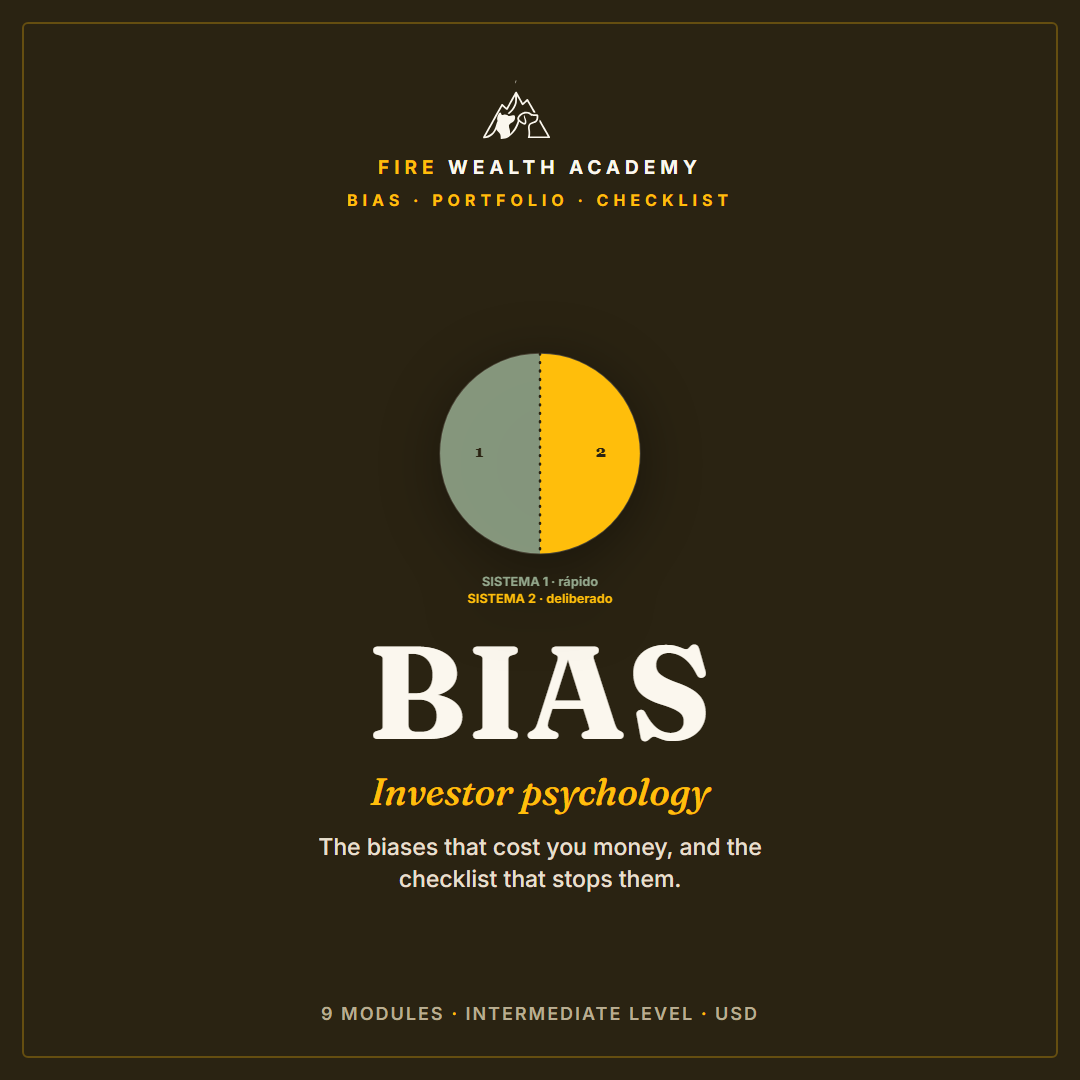
- System 1 and System 2: why deciding fast is not the same as deciding well.
- Loss aversion: why losing hurts roughly 2.25 times more than winning the same amount feels good.
- The disposition effect: why we sell winners early and cling to losers.
- Overconfidence: what trading more than you should actually costs, in figures.
- Confirmation bias, herd behavior and FOMO, anchoring and recency bias.
- The sunk cost fallacy, and when "cutting losses" is the rational move.
- A five-question checklist that stops bias before you trade, not after.
Every module closes with four worked exercises showing the full reasoning, not just the answer. Intermediate level. Universal: psychology does not change by country. One-time payment, lifetime access.
Educational content: this is not financial or psychological advice. The behavioral research coefficients and statistics cited are illustrative and approximate — they represent the general pattern documented in the literature, not the exact finding of any single study. Irene, Nortia, Zenta, and Quantia are fictional people and cases.
Your worst enemy as an investor is not the market. Learn to recognize it.
Contenido del curso
Module 1 · System 1 and System 2
-
System 1 and System 2
-
Exam · Module 1
Module 2 · Loss Aversion
Module 3 · The Disposition Effect
Module 4 · Overconfidence
Module 5 · Confirmation Bias
Module 6 · Herd Behavior and FOMO
Module 7 · Anchoring and Recency Bias
Module 8 · The Sunk Cost Fallacy
Module 9 · Synthesis: A Checklist to Rein In Bias
Valoraciones y reseñas de estudiantes
